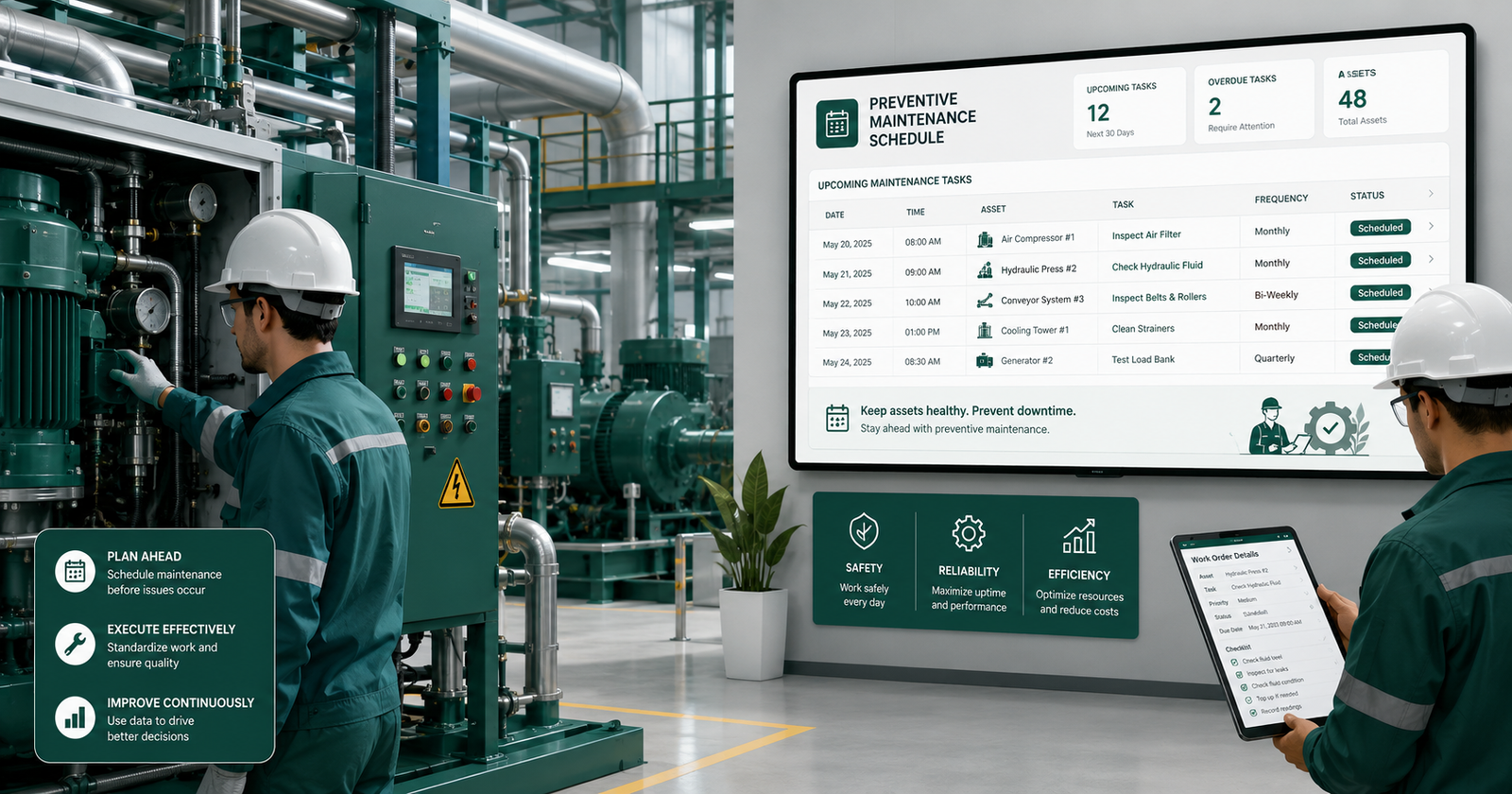
The preventive maintenance schedule is a crucial aspect of any manufacturing plant's operations, as it helps to ensure that equipment and machinery are functioning optimally, reducing downtime and increasing overall productivity. However, creating a preventive maintenance schedule that survives contact with reality can be a daunting task, especially in Indian manufacturing plants where resources are limited and equipment is often ageing. In this article, we will explore the importance of preventive maintenance, the challenges of creating a realistic schedule, and provide practical tips on how to create a schedule that works for your plant. We will also discuss how a Computerized Maintenance Management System (CMMS) can help streamline your maintenance operations and improve overall efficiency.
A well-planned preventive maintenance schedule can help reduce downtime, increase productivity, and improve product quality. According to a study by IBEF, the Indian manufacturing sector is expected to reach $1 trillion by 2025, and preventive maintenance will play a critical role in achieving this goal. However, creating a preventive maintenance schedule that survives contact with reality requires a deep understanding of the plant's operations, equipment, and resources. It also requires a willingness to adapt and adjust the schedule as needed, taking into account OEE (Overall Equipment Effectiveness) and TPM (Total Productive Maintenance) principles. By following a structured approach and using the right tools, such as a CMMS, plant managers and maintenance engineers can create a preventive maintenance schedule that is realistic, effective, and sustainable.
In a previous blog post, we discussed the high cost of downtime in Indian manufacturing plants, and how a preventive maintenance schedule can help reduce this cost. We also discussed the importance of tracking MTTR (Mean Time To Repair) and MTBF (Mean Time Between Failures) to improve maintenance efficiency. In this article, we will build on these concepts and provide a step-by-step guide on how to create a preventive maintenance schedule that survives contact with reality. We will also discuss how to use AssetAI to streamline your maintenance operations and improve overall efficiency. For more information on how AssetAI can help your plant, please visit our pricing page or contact us to book a demo.
Introduction to Preventive Maintenance
Preventive maintenance is a proactive approach to maintenance that involves performing regular tasks to prevent equipment failure and reduce downtime. It is a critical aspect of any manufacturing plant's operations, as it helps to ensure that equipment and machinery are functioning optimally, reducing downtime and increasing overall productivity. Preventive maintenance tasks can include routine inspections, cleaning, lubrication, and replacement of worn-out parts. By performing these tasks regularly, plant managers and maintenance engineers can identify potential problems before they occur, reducing the risk of equipment failure and downtime.
Types of Preventive Maintenance
There are several types of preventive maintenance, including:
- Routine maintenance: This involves performing routine tasks such as cleaning, lubrication, and inspection of equipment.
- Predictive maintenance: This involves using advanced technologies such as vibration analysis and infrared imaging to predict when equipment is likely to fail.
- Condition-based maintenance: This involves performing maintenance tasks based on the condition of the equipment, rather than on a fixed schedule.
Creating a Preventive Maintenance Schedule
Creating a preventive maintenance schedule that survives contact with reality requires a deep understanding of the plant's operations, equipment, and resources. It also requires a willingness to adapt and adjust the schedule as needed, taking into account OEE (Overall Equipment Effectiveness) and TPM (Total Productive Maintenance) principles. Here are some steps to follow:
- Identify the equipment and machinery that require preventive maintenance.
- Determine the frequency and type of maintenance tasks required for each piece of equipment.
- Create a schedule that takes into account the plant's operations, resources, and budget.
- Review and adjust the schedule regularly to ensure that it is working effectively.
Using a CMMS to Create a Preventive Maintenance Schedule
A CMMS (Computerized Maintenance Management System) can help streamline your maintenance operations and improve overall efficiency. With a CMMS, you can create a preventive maintenance schedule that is tailored to your plant's specific needs, and track and manage maintenance tasks and resources in real-time. For more information on how a CMMS can help your plant, please visit our features page or contact us to book a demo.
Best Practices for Preventive Maintenance
Here are some best practices for preventive maintenance:
- Develop a culture of maintenance excellence within your organization.
- Provide training and support to maintenance personnel.
- Use the right tools and equipment for maintenance tasks.
- Track and measure maintenance performance using metrics such as OEE (Overall Equipment Effectiveness) and MTTR (Mean Time To Repair).
- Continuously review and improve the preventive maintenance schedule.
Industry Standards for Preventive Maintenance
There are several industry standards for preventive maintenance, including ISO 9001 and ISO 55001. These standards provide guidelines for creating and implementing a preventive maintenance program, and can help ensure that your plant is operating safely and efficiently. For more information on industry standards, please visit our standards page.
Implementing a Preventive Maintenance Schedule
Implementing a preventive maintenance schedule requires a structured approach and a willingness to adapt and adjust the schedule as needed. Here are some steps to follow:
- Communicate the preventive maintenance schedule to all stakeholders, including maintenance personnel, production staff, and plant management.
- Provide training and support to maintenance personnel to ensure that they have the skills and knowledge needed to perform maintenance tasks.
- Use a CMMS (Computerized Maintenance Management System) to track and manage maintenance tasks and resources in real-time.
- Review and adjust the schedule regularly to ensure that it is working effectively.
Using AssetAI to Implement a Preventive Maintenance Schedule
AssetAI is a CMMS (Computerized Maintenance Management System) that can help streamline your maintenance operations and improve overall efficiency. With AssetAI, you can create a preventive maintenance schedule that is tailored to your plant's specific needs, and track and manage maintenance tasks and resources in real-time. For more information on how AssetAI can help your plant, please visit our pricing page or contact us to book a demo.
Conclusion
Creating a preventive maintenance schedule that survives contact with reality requires a deep understanding of the plant's operations, equipment, and resources. It also requires a willingness to adapt and adjust the schedule as needed, taking into account OEE (Overall Equipment Effectiveness) and TPM (Total Productive Maintenance) principles. By following a structured approach and using the right tools, such as a CMMS (Computerized Maintenance Management System), plant managers and maintenance engineers can create a preventive maintenance schedule that is realistic, effective, and sustainable. For more information on how AssetAI can help your plant, please visit our resources page to download our free guide to preventive maintenance, or contact us to book a demo. Additionally, you can visit our use cases page to see how other plants have successfully implemented preventive maintenance schedules using AssetAI. You can also visit our industries page to see how AssetAI can help your specific industry.